01
Health Impact
Nausea, dizziness, vomiting, long-term fatigue — repeated across every rough-sea period.
Severity88%
A self-stabilising projector that gives enclosed ship crew a constant visual horizon — ending the sensory mismatch behind motion sickness.
Crew work 10–12 hour shifts in enclosed interiors with no visual horizon. The brain receives conflicting signals — with debilitating results.
Nausea, dizziness, vomiting, long-term fatigue — repeated across every rough-sea period.
Reduced productivity and critical task errors — directly affecting ship operations and service quality.
Impaired focus and disorientation — posing real risks to crew and passengers in rough conditions.
Crew cannot leave posts to recover. Symptoms compound over the entire 10–12 hour shift.
The ship tilts — the projected horizon stays perfectly level. Your brain finally has a stable reference it can trust.
Detects constant tilting, rolling & vibration
See a static, windowless room — no horizon
Nausea, disorientation & cumulative fatigue
Three crew roles face the greatest exposure. Hover to reveal pain points.
Long hours in windowless kitchens under pressure — no ability to pause.
Constant movement through enclosed cabins — balance challenges all shift.
Navigate tight, uneven surfaces while maintaining professional demeanor.

"When the ship starts rolling, everything inside the galley moves — but my eyes have nothing fixed to hold on to. I feel it in my stomach first, then my hands start to shake. I've learned to just push through it, but it never gets easier. You can't leave. You can't stop. You just endure.
— Francis, during rough sea state 4
Francis has been cooking at sea since his early thirties — long enough that the work itself is second nature. It's the environment that wears him down. The galley sits two decks below the waterline, a sealed box of stainless steel with no portholes, no horizon, no way to tell up from down except through the floor beneath his feet. On calm days it's manageable. When the weather turns, his body starts fighting him before his mind even registers the change.
He knows the medication exists. He rarely takes it — it makes him drowsy, and a drowsy cook in a moving kitchen is a dangerous one. So instead he grips the counter, widens his stance, and works through the nausea. He's never been asked what would help. No one has.
The design challenge that shaped every decision.
Early sketches exploring how a self-stabilising projector could solve the sensory conflict problem — before a single component was sourced.
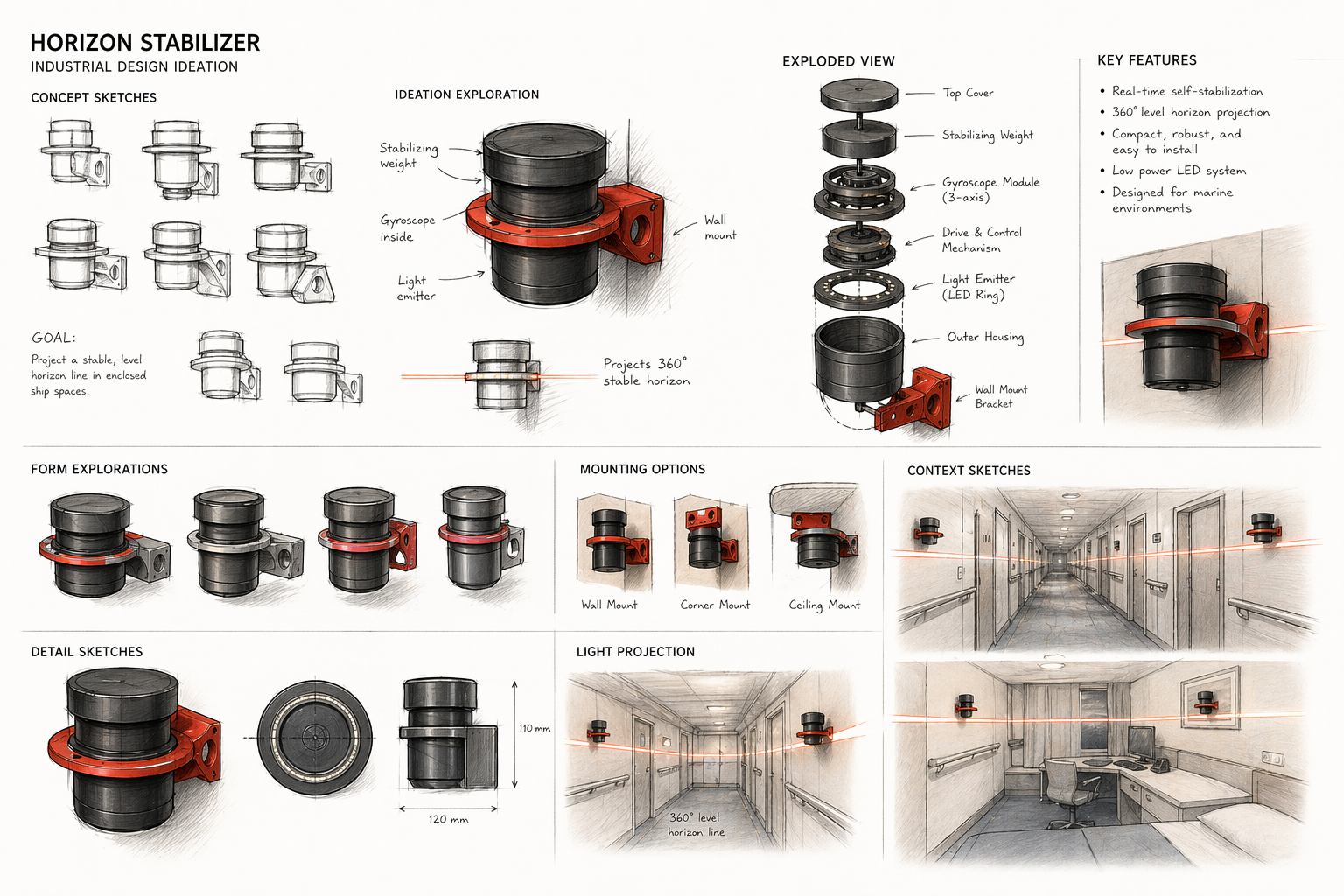
A gimbal-mounted projector housing that uses a counterweight to stay level as the ship rolls — no active electronics needed for the stabilisation itself.
Seven layers: Top Cover → Stabilising Weight → Gyroscope Module → Drive & Control → LED Ring Emitter → Outer Housing → Wall Mount Bracket.
Compact cylindrical body with the red accent ring marking the active emitter zone — industrial aesthetic that reads as safety equipment, not consumer tech.
Wall mount for corridors, corner mount for enclosed cabins, ceiling mount for open mess decks — one device, three installation configurations.
Compact footprint at ~180 × 120mm, sized to fit existing ship wall conduit brackets with no structural modification to the vessel.
The red horizon line projected across a ship corridor wall — at eye height, continuous from bow to stern, visible without looking for it.
"Project a stable, level horizon line in enclosed ship spaces — passively, reliably, without disrupting crew workflow."
Decades of peer-reviewed neurophysiology and vestibular science. Click any card to read more.
Motion sickness arises from asynchronisation between visual and vestibular cues. The brain expects aligned signals — conflict produces nausea.
Viewing a fixed horizon line significantly reduces seasickness symptoms. A true horizon reference is uniquely effective — arbitrary visual cues don't substitute.
The brain maintains an internal model of "vertical." Sickness occurs when visual vertical misaligns with actual gravitational direction.
Stable artificial visual references reduce motion sickness in flight simulators and VR — validating the principle beyond maritime contexts.
A self-stabilising gimbal device mounts to any interior wall. As the ship rolls, the outer chassis tilts — but the inner gimbal counter-rotates, keeping the projected horizon perfectly level. Drag the slider to feel it.
Gyroscopic sensors keep the projection perfectly level regardless of ship pitch and roll — up to ±25°.
A continuous warm beam acts as an artificial horizon — the visual anchor that resolves the sensory conflict.
Compact wall-mount unit rated for marine environments. Fits corridors, galleys, and crew cabins.
Always on, entirely passive. Assists every crew member in the space simultaneously, with no user action required.
A 3D-printed gimbal mechanism proves the core concept: a self-levelling mount keeps the light emitter horizontal regardless of chassis tilt.
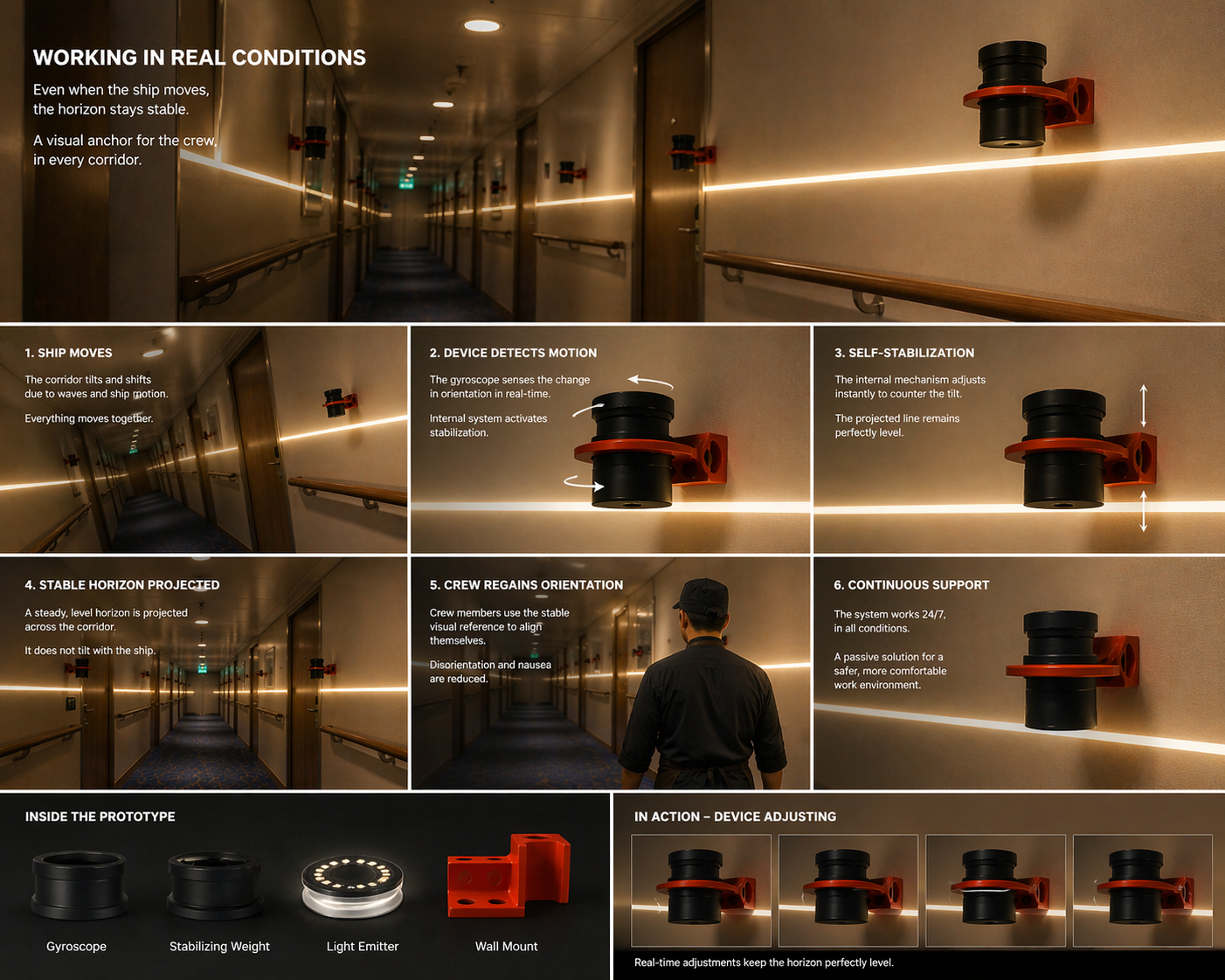
Six-step mechanism from ship motion detection to stable projected horizon, with component breakdown: gyroscope, stabilising weight, light emitter, and wall mount.
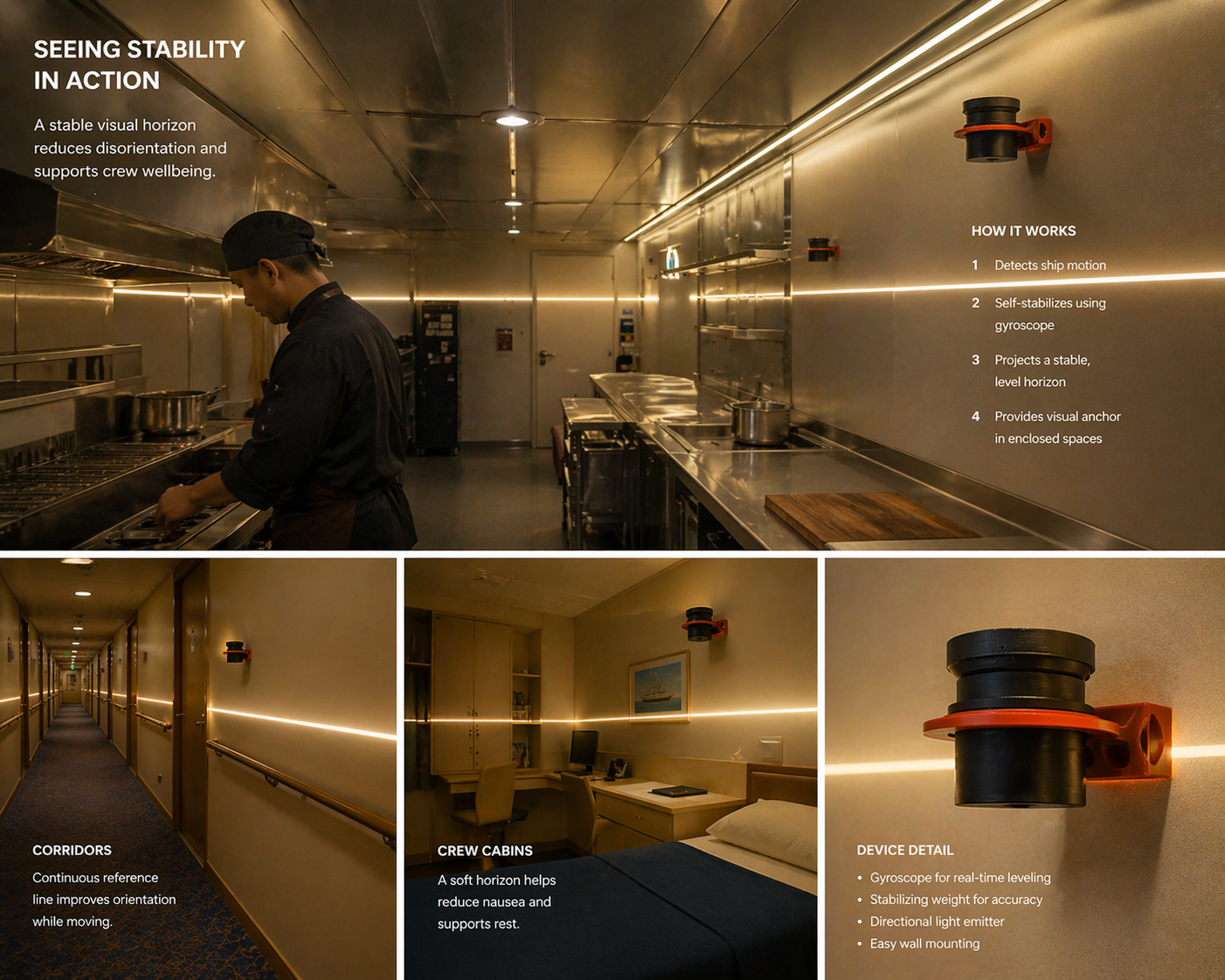
HorizonLine deployed across three ship environments — galley kitchen, crew corridor, and sleeping cabin — each receiving a continuous level reference line at eye height.
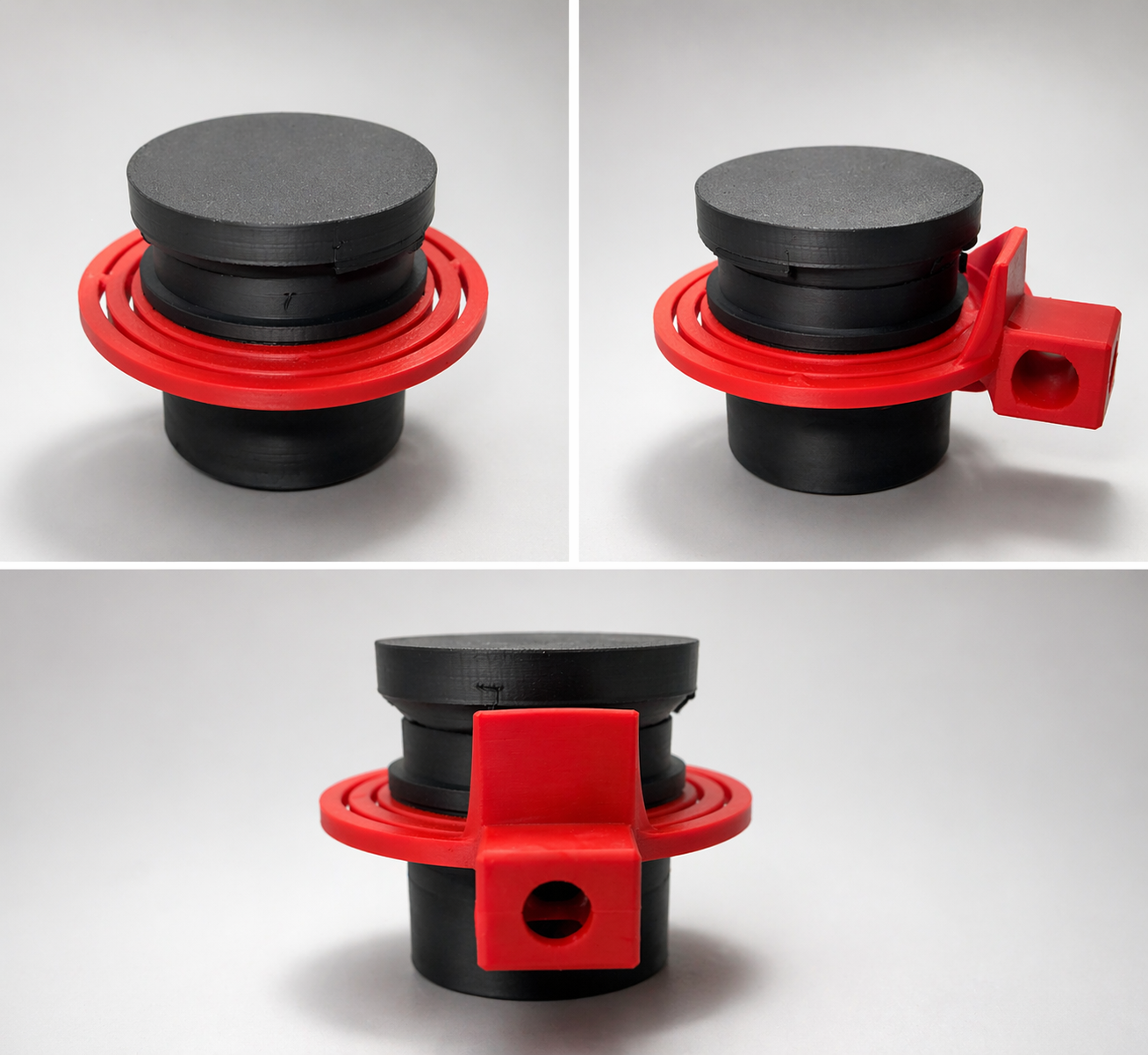
The core of the prototype: a black cylindrical projector housing suspended inside a red gimbal ring. As the chassis tilts with the ship, the inner mass stays perfectly level under gravity — validating the stabilisation principle without any electronics.
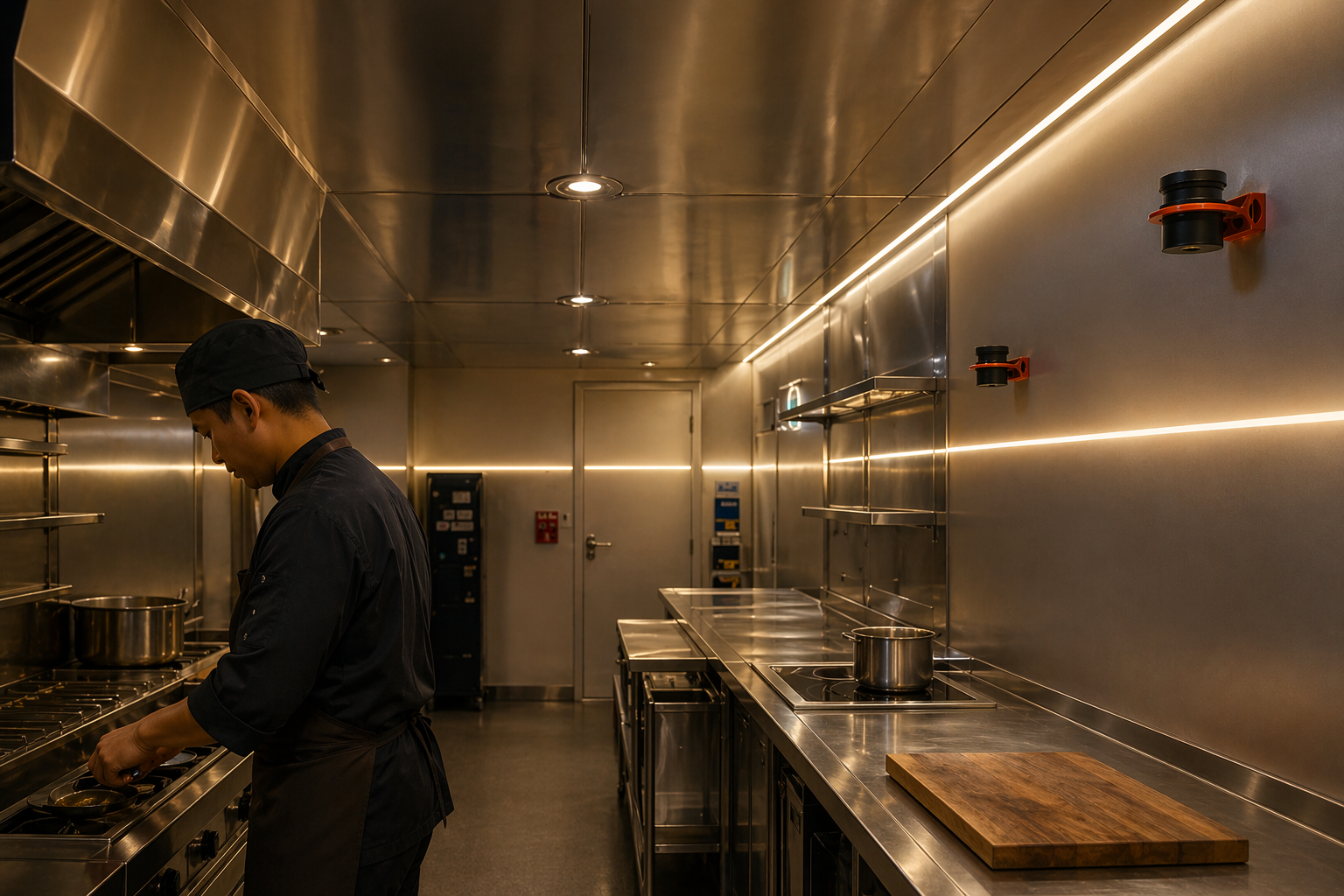
The device mounts flush to the wall. Its projected line runs the full length of the galley at eye level — giving the cook a stable visual anchor as the ship rolls. Zero disruption to the workspace; zero crew interaction required.
The mechanical gimbal successfully demonstrated passive self-levelling across ±25° of tilt — matching the roll envelope of most passenger vessels in sea state 4–5. The next iteration will integrate a laser line diode and real-time gyroscope active correction for precision below ±0.5°.
The HorizonLine projector maintains a perfectly level visual reference as the vessel rolls — eliminating the sensory mismatch that causes motion sickness.
The vessel hull tilts with wave motion — the enclosure loses all visual stability reference.
Gravity acts on the counterweight, passively rotating the projector head back to level in real time.
The projected line remains horizontal on the wall — giving the brain a stable anchor regardless of tilt.
From sensory conflict to restored orientation — four steps, zero user effort.
The ship moves. Inner ear detects it. Eyes see a static windowless room. Neural conflict initiates nausea.
The gimbal device projects a perfectly horizontal line onto the wall — always level, always there.
The stable line allows the brain to reconcile vestibular and visual inputs — the conflict signal drops.
Nausea subsides. Crew continues working. No interruption, no wearable, no workflow change.
An honest assessment — where the design excels and where careful implementation matters.
Zero user interaction. Works continuously in the background without cognitive demand.
One device assists all crew in visual range — unlike personal solutions like wristbands.
Mounts into existing interiors. No wearables, no training, no workflow change.
Directly translates validated research into a practical, deployable product.
Requires clear line of sight. Crowded galleys or narrow corridors may limit coverage.
Needs sufficient contrast. Bright lighting may require adaptive brightness control.
High-precision gimbal stabilisation is essential. Any drift reduces effectiveness.
Response to visual cues varies. The solution may not be equally effective for all crew.
From immediate crew relief to scalable B2B maritime product.
Constant orientation cues during food prep and service
Anchors at key junctions benefit mobile crew throughout
Accelerated recovery during rest between long shifts
Real, widely-cited research underpinning the HorizonLine concept.
Reason, J. T., & Brand, J. J. (1975). Motion sickness. Academic Press.
Oman, C. M. (1990). Motion sickness: Sensory conflict theory. J. Vestibular Research, 1(1), 1–15.
Golding, J. F. (2016). Motion sickness susceptibility. Autonomic Neuroscience, 129.
Bertolini & Straumann (2016). Moving in a moving world. Frontiers in Neurology, 7, 14.
Ebenholtz, S. M. (1992). Visual horizon in motion sickness. Perception, 21(4).
Stoffregen & Smart (1998). Postural instability precedes sickness. Brain Research Bulletin.
Keshavarz et al. (2015). Vection and motion sickness. Frontiers in Psychology, 6, 472.
Duh et al. (2004). Conflicting motion cues in visual environments. Aviation, Space & Enviro. Medicine.
Keshavarz, Hecht & Lawson (2014). Visually induced motion sickness. Handbook of Virtual Environments.